How to Choose a Daycare in Surrey, BC: A Parent’s Checklist
Choosing childcare is one of the first big decisions you make on behalf of your child, and in Surrey it often has to be made quickly — waitlists are long and good spaces fill fast. The pressure to “just take the spot” is real.
This checklist is written to slow that decision down by about an hour. Work through it before you tour, take it with you on the visit, and you will know far more about a program than a website or a Facebook group can tell you.
1. Start with the licence, not the photos
In British Columbia, childcare programs are licensed and inspected by the regional health authority. In Surrey that is Fraser Health. A licensed program has been checked for facility safety, first aid, immunization records, staff criminal record checks, emergency planning, and record keeping.
Before anything else, look the program up in the Fraser Health childcare facility search. You can read its licence type, its maximum capacity, and its inspection and complaint history. If a program is unlicensed, it is not automatically unsafe — but it has never been independently inspected, and you carry all of that risk yourself.
- Confirm the licence type matches the ages you need (Group, Family, In-Home Multi-Age, Preschool, or Out of School Care).
- Read the two most recent inspection reports, not just the current status.
- Ask how any past infractions were resolved — a well-run program will answer this openly.
Sonia’s Tiny Toons is a licensed family day care in Surrey, BC, operating under Fraser Health licensing with a maximum of 7 children.
2. Understand group size and what it actually means for your child
Ratios tell you how many adults are present. Group size tells you how loud, how busy, and how overwhelming the room feels. Both matter, and for children under three, group size often matters more.
A large centre can be excellent — more staff, more equipment, more coverage when someone is sick. A small family day care offers something different: the same familiar adult every single day, a predictable set of playmates, and a home-scale environment where a shy child is not lost in the crowd. Neither is objectively better. What matters is which one fits your child’s temperament.
- Ask for the maximum number of children present at the busiest hour of the day, not the licensed capacity on paper.
- Ask how many different adults your child would interact with in a typical week.
- Ask what happens when the primary caregiver is ill — who steps in, and has your child met them?
3. Walk the space with safety eyes
On a tour you are naturally looking at the toys. Try to look past them for ten minutes and check the boring things instead, because those are the ones that protect your child.
- Sleep space: separate cribs or cots, firm mattresses, nothing soft or loose for infants.
- Outlets covered, cords secured, heavy furniture anchored, cleaning products locked and out of reach.
- A visible, current first aid certificate and an emergency plan posted where parents can read it.
- Hand-washing routines built into the day — before meals, after diapering, after outdoor play.
- Secure entry, and a written policy about who is allowed to pick your child up.
- Outdoor play space, or a specific daily plan for getting children outside in Surrey’s wet months.
4. Ask to see a real daily routine
A predictable rhythm is one of the strongest predictors of a child settling in well. Young children cannot read a clock, so they read the sequence of the day: arrival, snack, outside, lunch, rest, play, home.
Ask for the actual routine, in order, with times. Then ask what happens when it goes wrong — when a child will not nap, when it rains all week, when two children want the same toy. The answers to those questions tell you more about a program’s philosophy than any printed mission statement.
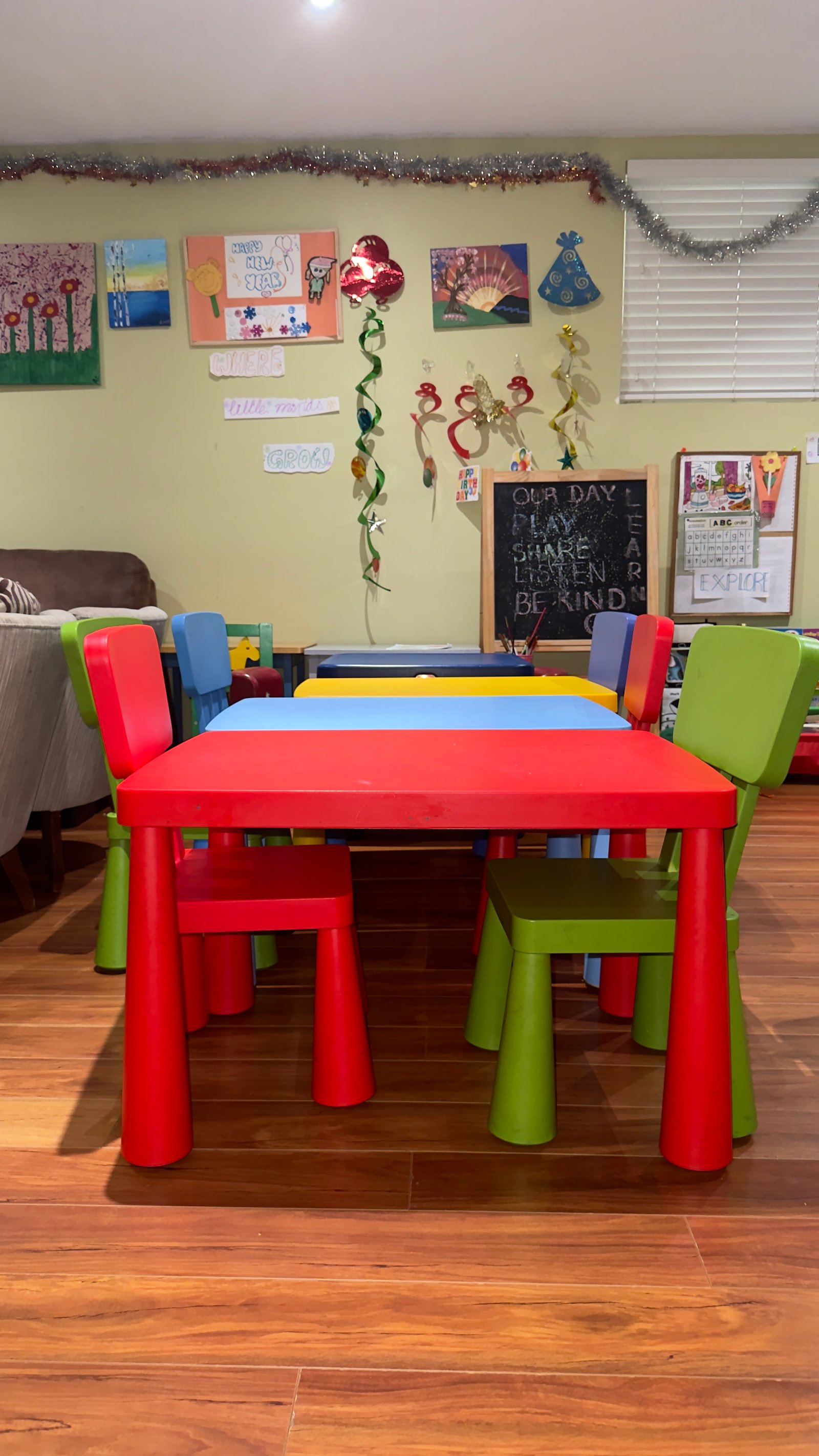
At Tiny Toons the day runs on a posted routine — circle time, guided play, outdoor time, home-cooked meals, quiet rest — so children always know what comes next.
5. Ask about food, language and inclusion
Surrey is one of the most linguistically diverse cities in Canada, and childcare is where many children first navigate more than one language. Ask which languages are spoken in the program, and whether your home language is understood. Children settle faster when a caregiver can comfort them in words they already know.
Food matters just as much. Ask who prepares meals, whether the menu rotates, how allergies are managed, and whether meals are included in the fee or extra. Home-cooked food and a shared table also do quiet developmental work: turn taking, self-serving, trying new textures.
- Which languages do caregivers speak?
- Are meals and snacks included, and can you see a sample week’s menu?
- How are allergies, dietary restrictions and cultural food preferences handled?
6. Get the money in writing
Before you commit, ask for the full fee schedule in writing: monthly fee, deposit, late pick-up charges, statutory holiday and vacation policy, notice period to withdraw, and what happens to fees when your child is sick.
Then ask specifically whether the program participates in the Child Care Fee Reduction Initiative (CCFRI) and accepts the Affordable Child Care Benefit (ACCB). These two BC programs change what families actually pay, sometimes dramatically. A program that is enrolled in CCFRI applies the reduction directly to your invoice.
Tiny Toons participates in CCFRI and supports ACCB applications, so eligible Surrey families pay a reduced monthly fee.
7. Red flags worth walking away from
Most programs you tour will be fine. A few will not be. These are the signals that should end a tour early, regardless of how urgently you need the space.
- Reluctance to show you the sleep area, the kitchen, or the outdoor space.
- No written policies on discipline, illness, or emergencies.
- Discipline described in terms of punishment or isolation rather than redirection and coaching.
- Pressure to pay a large non-refundable deposit before you have seen a contract.
- Children who look unsupervised, or a caregiver who cannot tell you what each child is doing.
- Vague answers about licensing status.
8. Trust the tour, then trust the first month
Bring your child to the tour if you can. Watch whether the caregiver speaks to them directly, at their eye level, before speaking to you. That single detail is remarkably predictive.
After you enrol, give it a month of honest observation. Does your child talk about the caregiver by name? Do they separate more easily by week three than week one? Do you get real, specific updates — not just “good day”? Those are the signs that the fit is right.
Frequently asked questions
- How do I check if a Surrey daycare is licensed?
- Search the facility on the Fraser Health childcare licensing directory. It shows licence type, capacity, inspection reports and any substantiated complaints. Programs should also be able to show you their licence on request.
- Is a family day care as good as a large centre?
- Both can be excellent. A family day care offers a small group, one consistent caregiver and a home environment, which suits children who need calm and continuity. A large centre offers more staff and equipment. Match the setting to your child, not to the size.
- How far in advance should I look for childcare in Surrey?
- Six to twelve months ahead is realistic for infant spaces. Join waitlists early and keep them updated, because programs regularly release spaces when families move or children age into kindergarten.
See how Tiny Toons does it
Licensed family day care in Surrey, BC. Maximum 7 children, ages 6 months through Grade 5, English / Hindi / Punjabi, CCFRI & ACCB supported.